
 E-submission

Search
- Page Path
- HOME > Search
Original Article
- Diagnostic pitfalls leading to delayed diagnosis of human papillomavirus (HPV)–independent cervical malignancies in the era of HPV-based screening: clinicopathologic analysis of diagnostic pathways
- Hye Eun Park, Hye-Ra Jung, Hyun-Jung Kim
- J Pathol Transl Med. 2026;60(6):670-679. Published online November 13, 2026
- DOI: https://doi.org/10.4132/jptm.2026.08.26
- 42 View
- 0 Download
-
 Abstract
 PDF
- Background
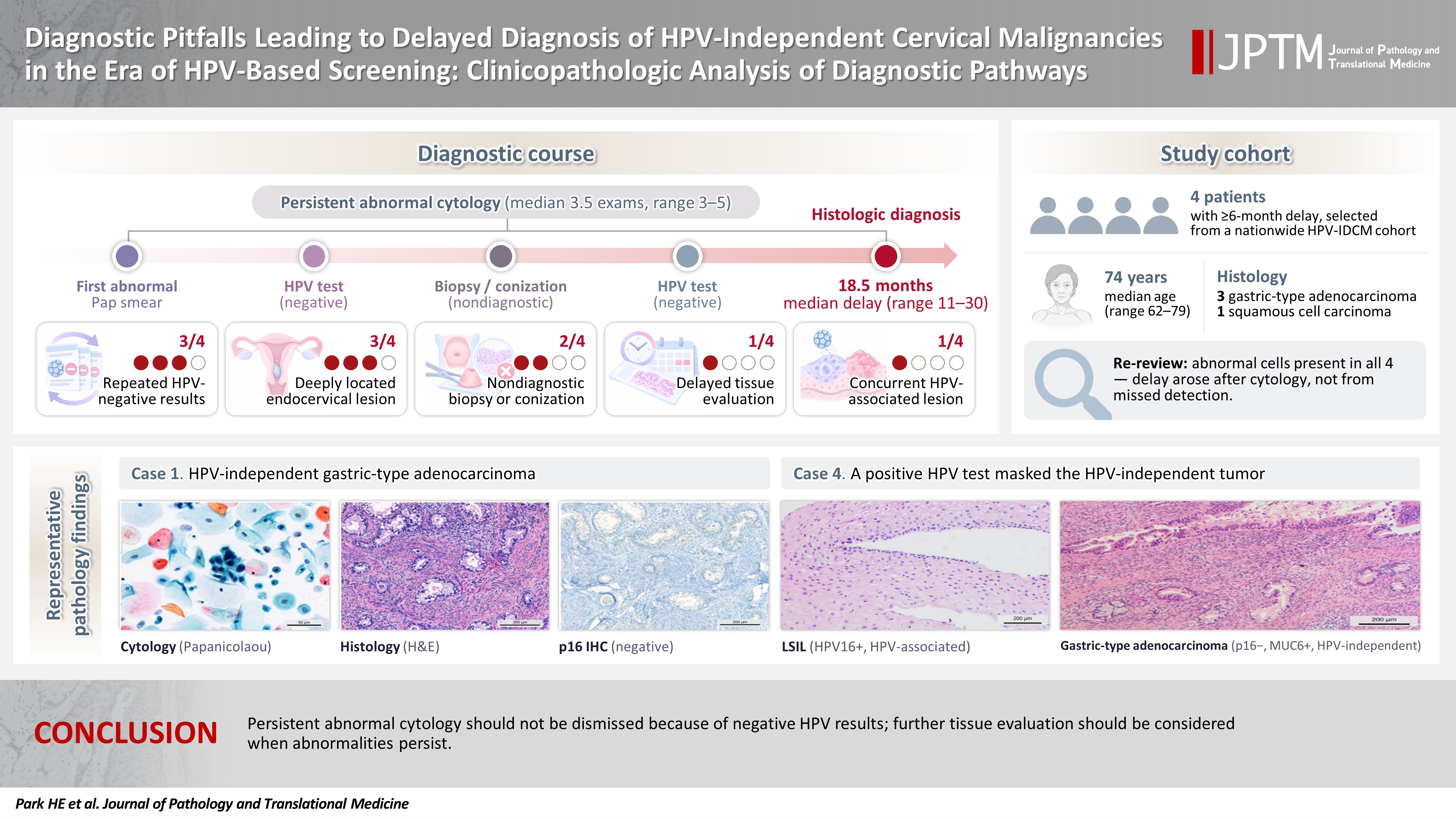
Human papillomavirus (HPV)–independent cervical malignancies (HPV-IDCM) are a rare but clinically important subset that may escape detection by HPV-based screening. This study investigated diagnostic pitfalls contributing to delayed HPV-IDCM diagnosis and assessed the role of cervical cytology in the diagnostic pathway. Methods: This multicenter retrospective case series was conducted as a policy research project of the Korean Society for Cytopathology. Patients with HPV-IDCM and repeated abnormal cytologic findings before definitive histologic diagnosis were identified. Clinical, cytologic, histologic, and HPV test results were reviewed to identify factors associated with diagnostic delay. Results: Four patients were included, with a median age of 74 years (range, 62 to 79 years). Histologic diagnoses comprised three HPV-independent gastric-type adenocarcinomas and one HPV-independent squamous cell carcinoma. The median interval from the first abnormal cytologic finding to definitive diagnosis was 18.5 months (range, 11 to 30 months). Before diagnosis, all patients underwent a median of 3.5 cytologic examinations (range, 3 to 5). Associated factors included repeatedly negative HPV test results (3/4), nondiagnostic biopsy or conization (2/4), delayed tissue evaluation despite persistent cytologic abnormalities (1/4), deeply located endocervical lesions (3/4), and a concurrent HPV-associated squamous lesion (1/4). Re-review identified atypical or malignant cells in all cases, indicating that the delay did not result from failure of cytologic detection. Conclusions: HPV-IDCM remain vulnerable to delayed diagnosis in the era of HPV-based screening. Persistent abnormal cytologic findings should not be dismissed solely because HPV test results are negative. Careful correlation of cytologic, clinical, and histologic findings remains essential for timely HPV-IDCM detection.
 First
 Prev




