
 E-submission

Search
- Page Path
- HOME > Search
Original Article
- A demographic study of pathology-proven kidney tumors at a single institution in South Korea over the past 33 years: 1991–2023
- Seon Ung Kim, Hyejin Noh, Jiyeon Kim, Yeong Jin Choi
- J Pathol Transl Med. 2026;60(6):657-669. Published online November 13, 2026
- DOI: https://doi.org/10.4132/jptm.2026.10.19
- 36 View
- 1 Download
-
 Abstract
 PDF
- Background
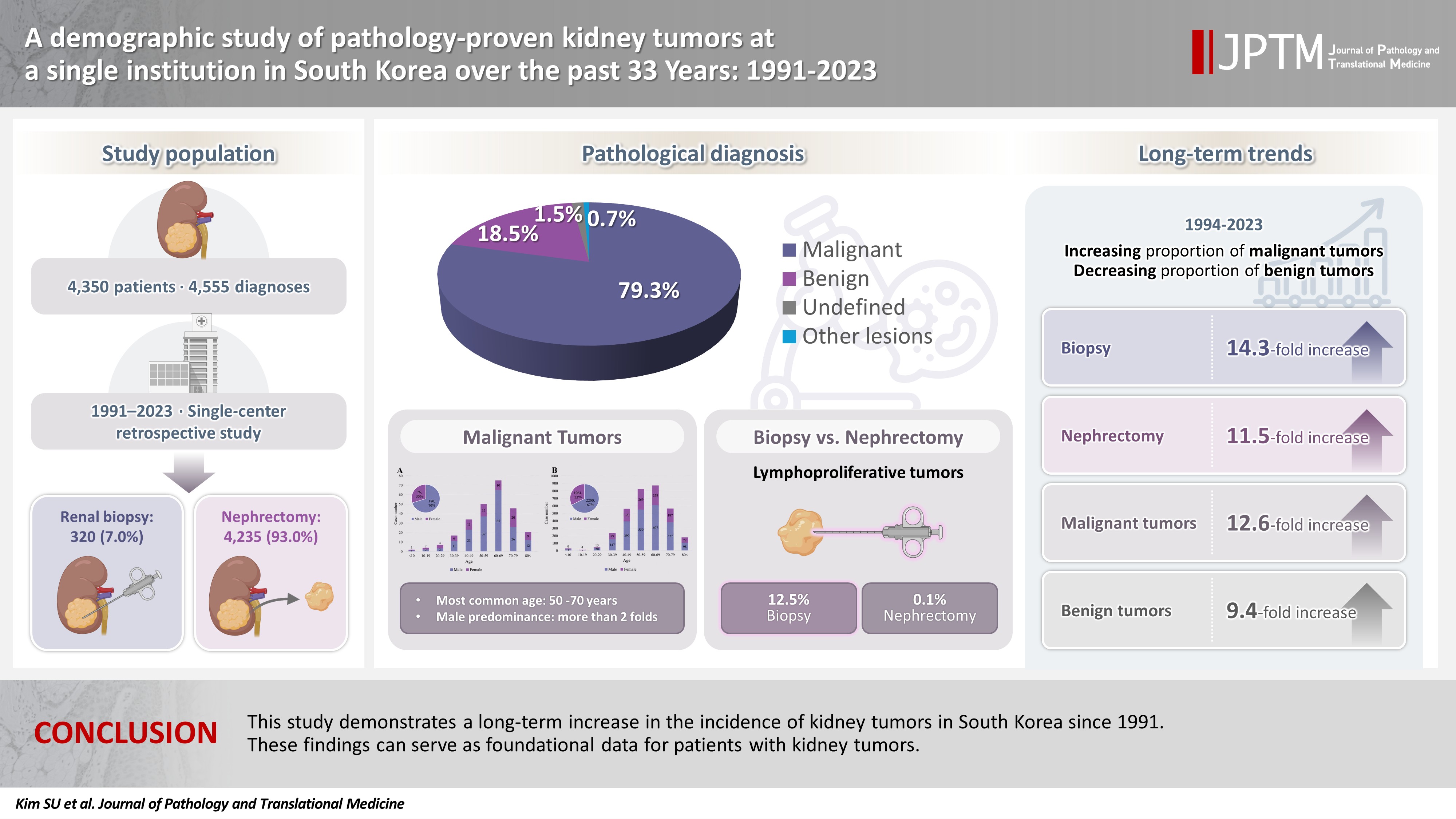
While the incidence of kidney tumors is increasing, long-term demographic analyses based on pathological diagnoses remain insufficient. This study aimed to investigate demographic changes regarding pathology-proven kidney tumors over the past 33 years. Methods: We retrospectively analyzed 4,555 cases from 4,350 patients who underwent renal biopsy or nephrectomy for suspected kidney tumors at Seoul St. Mary’s Hospital from 1991 to 2023. Results: The average age was 58 years, and the male-to-female ratio was 1.7:1. Among 4,555 cases, 7.0% were biopsies and 93.0% were nephrectomies. Tumors were classified into four diagnostic categories: malignant (79.3%), benign (18.5%), undefined (1.5%), and other lesions (0.7%). Over 33 years, biopsies increased 14.3-fold and nephrectomies 11.5-fold, while malignant tumors increased 12.6-fold and benign tumors 9.4-fold. Over time, the proportion of malignant tumors increased (p < .001), while benign tumors decreased (p < .001). As age increased, the proportion of malignant tumors increased (p = .013), while benign tumors showed a decreasing trend (p = .070). Malignant tumors showed a male predominance, while benign tumors showed a female predominance. The frequency of malignant tumors was similar at approximately 80% in biopsy and nephrectomy. However, benign tumors were more common in nephrectomy (19.1%) than in biopsy (10.9%) (p < .001), and unclassified tumors (4.1%) were more common in biopsies (p < .001). Renal cell carcinoma was most common (61.5% of total cases, 77.6% of malignant tumors). Lymphoproliferative tumors were diagnosed more frequently by biopsy (12.5%) than nephrectomy (0.1%) (p < .001). Conclusions: This study demonstrates a long-term increase in the incidence of renal tumors in South Korea. These findings can serve as foundational data for patients with kidney tumors.
 First
 Prev




