
 E-submission
Search
- Page Path
- HOME > Search
Original Articles
- A single-institution demographic study of pathologically proven kidney disease in South Korea over the last 33 years
- Hyejin Noh, Jiyeon Kim, Yeong Jin Choi
- J Pathol Transl Med. 2025;59(5):306-319. Published online September 10, 2025
- DOI: https://doi.org/10.4132/jptm.2025.06.18
- 4,300 View
- 105 Download
- 1 Web of Science
- 1 Crossref
-
 Abstract
 PDF
PDF Supplementary Material
 - Background
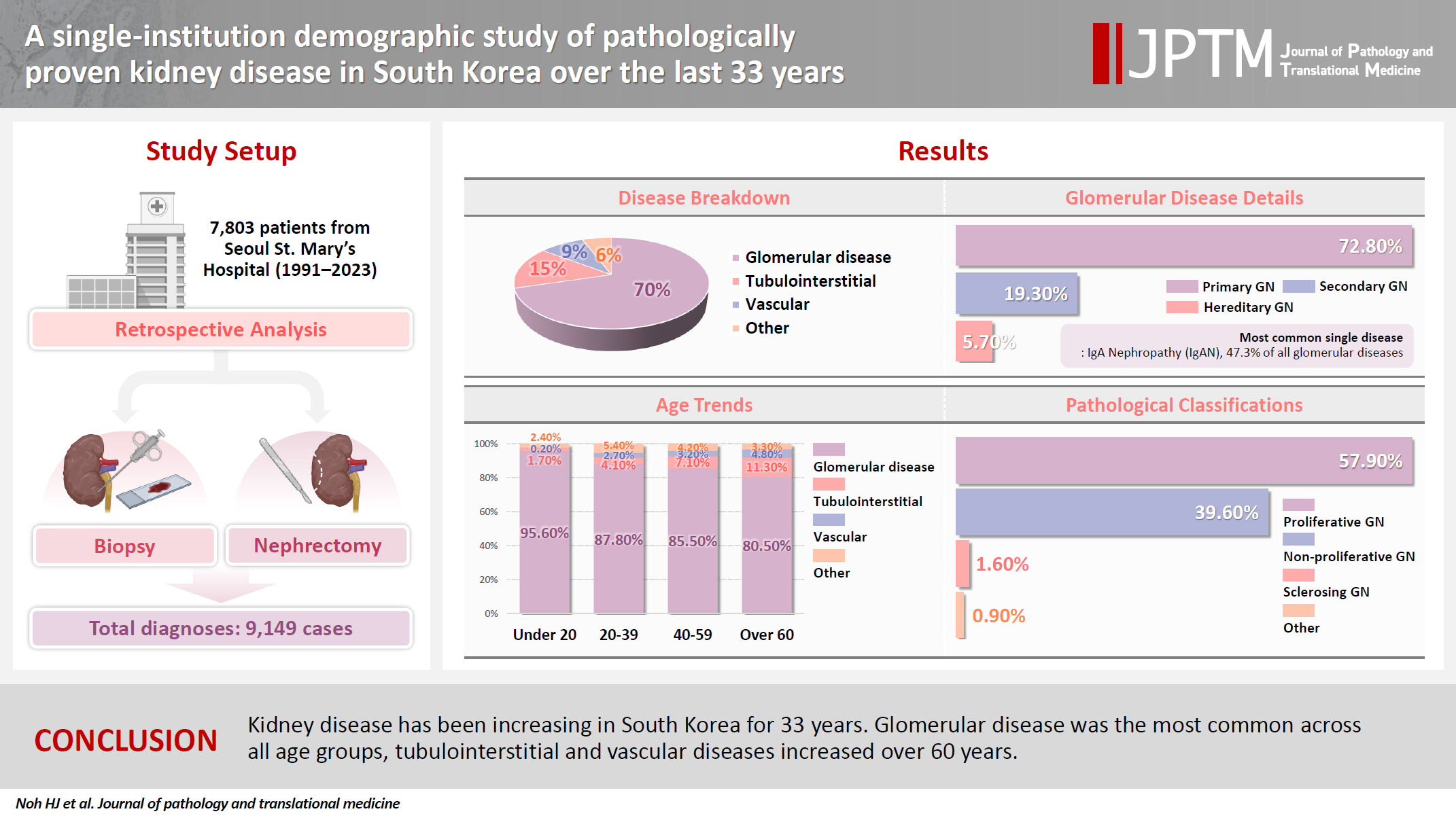
To date, epidemiological studies on the entire spectrum of kidney disease based on pathology have been rarely reported. Methods: A retrospective study was conducted on patients diagnosed with kidney disease at Seoul St. Mary's Hospital between 1991 and 2023. Results: Among 7,803 patients with native kidney disease, glomerular disease (70.3%) was the most common, followed by tubulointerstitial (15.1%) and vascular disease (8.8%). In kidney biopsy, glomerular disease (77.8%) showed the highest frequency, particularly in those under 20s (95.6%) (p = .013). Primary glomerulonephritis (GN) (72.8%) was the predominant glomerular disease, with IgA nephropathy (IgAN) (47.3%) being the most common one. Tubulointerstitial and vascular diseases increased with age, showing the highest prevalence in those over 60 years (p = .008 and p = .032, respectively). Glomerular disease was diagnosed at a younger age (39.7 ± 16.7 years) than tubulointerstitial (49.1 ± 16.2) and vascular (48.1 ± 15.3) diseases (p < .001). When glomerular diseases were classified morphologically, proliferative GN (57.9%) was the most common, followed by non-proliferative (39.6%) and sclerosing (1.6%). When classified by etiology, primary GN accounted for the most (72.8%), followed by secondary (19.3%) and hereditary GN (5.7%). In nephrectomy, tubulointerstitial disease (64.6%) was the most common. Those with a tubulointerstitial disease had a higher mean age than those with a glomerular disease (p < .001). In cases where nephrectomy was performed for glomerular diseases, IgAN (34.1%) was the most common diagnosis. Conclusions: Kidney disease has been increasing in South Korea for 33 years. Glomerular disease was the most common across all age groups, tubulointerstitial and vascular diseases increased over 60 years. -
Citations
Citations to this article as recorded by
- A single-institution demographic study of pathologically proven renal disease in kidney transplant recipients over the last 33 years
Hyejin Noh, Jiyeon Kim, Yeong Jin Choi
Journal of Pathology and Translational Medicine.2026; 60(4): 398. CrossRef
- A single-institution demographic study of pathologically proven renal disease in kidney transplant recipients over the last 33 years
- Pathological and Epidemiological Analysis of Gastric Carcinoma among Koreans in Pusan Area.
- Sook Nyo Lee, Dongsoo Suk, Yeon Jae Cheong, Sun Kyung Lee
- Korean J Pathol. 1990;24(4):375-385.
- 2,176 View
- 12 Download
-
Abstract
PDF
- Epidemiology, pathology, diagnosis and treatment of gastric carcinoma has been revised recently. The authors analysed 3,170 cases of gastric carcinoma which were diagosed with fiberoptic biopsy or resected specimens from 1968 to 1988 in Pusan area. The specimen were collected from Pusan National University Hospital, Pusan Paik Hospital and other general hospitals in Pusan city. The results obtained were summarized as follows; 1) The time trend indicated that difference in the annual fluctuation of requency of gastric carcinoma during last 21 years was not statistically significant. But it was noticed that by comparing the following the two decades (1970~1979 and 1980~1988) the frequency of gastric carcinoma decreased in male, in middle age and in intestinal type. 2) Morbidity of gastric carcinoma increased in both sexes by aging, and this tendency was more marked in male and in intestinal type in female and in diffuse type. 3) In general the gastric carcinoma involved more frequently distal portion than proximal portion of the stomach was characterized predominantly by male, older patients and intestinal type. 4) Carcinoma with Borrmann type I and II were characterized predominantly by male, older patients and intestinal type. With Borrmann type III and IV, female, young patients and diffuse type were found more frequently. From the above results, the authors concluded that the pathological and epidemiological findings of gastric carcinoma among Koreans in Pusan area showed a transition moving from high risk to low risk area of gastric carcinoma.
- The Current Practice of the Autopsy Services and the Autopsy Records at the Seoul National University Hospital.
- Jeong Wook Seo, Yoon Sung Lee, Je Geun Chi, Ghee Young Choe, Soong Deok Lee, Chong Jai Kim, In Ae Park, Woo Ho Kim, Ja June Jang, Chul Woo Kim, Seong Hoe Park, Jung Bin Lee, Hyun Soon Lee, Yong Il Kim, Eui Keun Ham, Sang Kook Lee
- Korean J Pathol. 1998;32(6):453-459.
- 2,574 View
- 10 Download
-
Abstract
- This study outlines the current status of the autopsy practice and the medical records for autopsies at the Department of Pathology, Seoul National University Hospital. Total number of autopsy cases from 1954 to 1995 was 3,131. Adults aged over 17 were 371 cases and children were 2,515 cases. The demographic data in 245 cases was not available. The number of adult autopsies and its proportion among total number of autopsies during 10-year periods decreased from 144 cases (40%) during the 10-year-period from 1956 to 52 cases (3%) during the 10-year-period from 1986. The number of children cases during the same period groups increased slightly from 210 cases (58%) to 393 cases (25%). But the number of fetal cases increased rapidly from 7 cases (2%) to 1,146 cases (72%). Among fetal autopsies the proportion of fetuses died earlier than 24 weeks of gestation increased and this figure exceeds that of fetuses that died later than 24 weeks of gestation from 1992. Forty percent of the cases were submitted from the clinical departments of the Seoul National University Hospital but the remainders were referred from 73 hospitals. Final autopsy diagnoses were analysed according to the Korean Standard Classification of Disease (KCD)-3 coding system and by searching key words for all cases. Common diagnoses as coded among cases from 1990 were P9, P0, P2, Q2 and Q0. Common diseases by key words for adult cases were liver disease, tuberculosis and pneumonia. Common diseases for children cases were pneumonia, hyaline membrane disease, meningitis and tuberculosis. Through this study we could show the importance of autopsy services for fetuses. We could also establish a regular registration system for autopsies at general hospitals.
 First
First Prev
Prev



