
 E-submission
Search
- Page Path
- HOME > Search
Review Article
- Obesity-driven adipokine signaling in breast cancer: mechanistic insights, therapeutic challenges, and opportunities for precision oncology
- Vadakke Kunnumma Soonu, Praveen Kumar Shenoy, Valiyaparampil Gopi Deepak Roshan, Vipin Gopinath, Krishnan Sreejith
- J Pathol Transl Med. 2026;60(5):476-492. Published online September 9, 2026
- DOI: https://doi.org/10.4132/jptm.2026.06.30
- 1,757 View
- 29 Download
-
 Abstract
 PDF
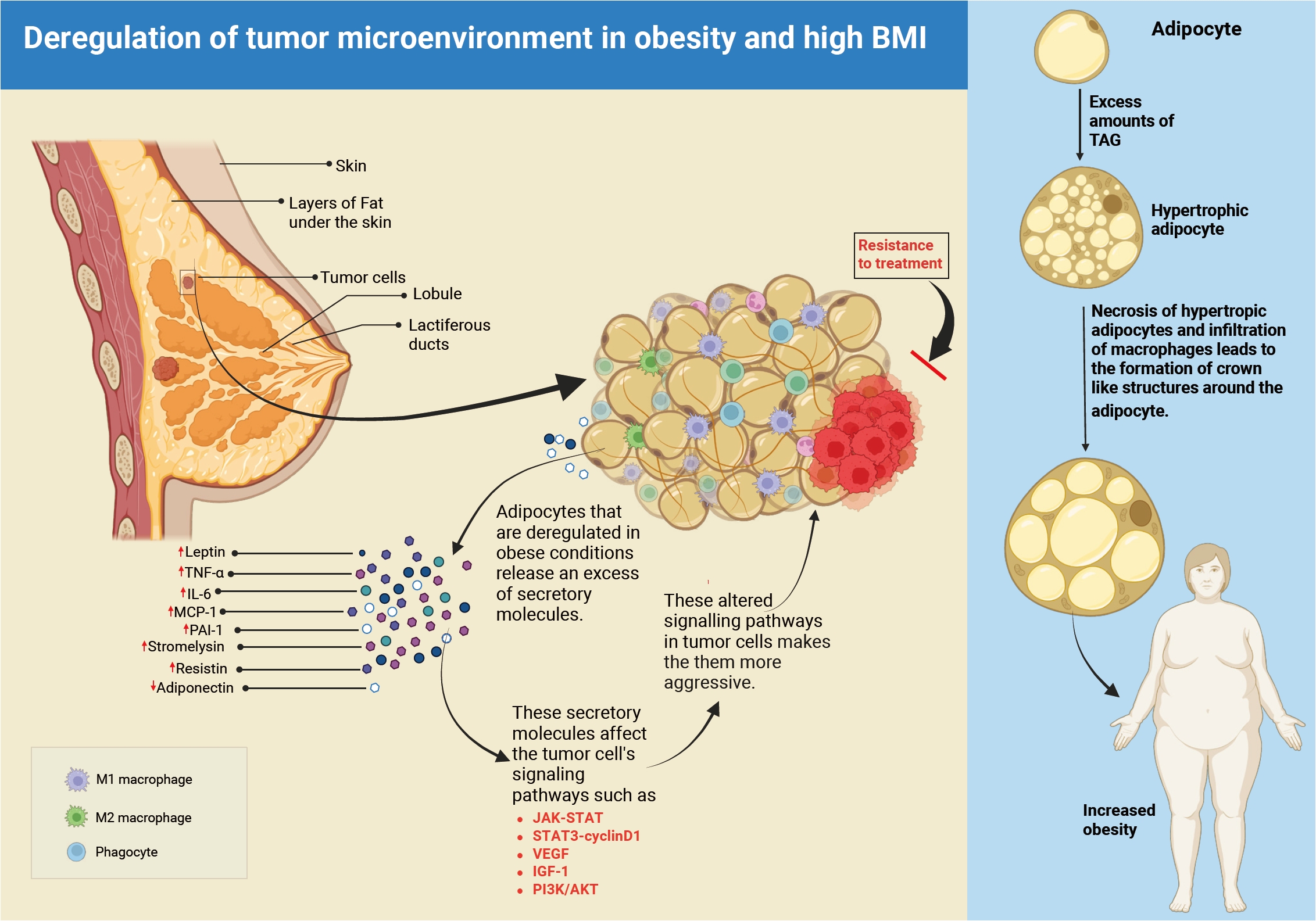
PDF - Breast cancer is the leading cause of illness and death among women worldwide, with more than 2.3 million new cases diagnosed each year. The incidence and fatality rates are steadily increasing, notably in Asian countries. Obesity has been established as a major and growing risk factor for breast cancer progression. The World Health Organization reports that adult obesity rates have doubled since 1990. Obesity promotes tumor growth by inhibiting adipokine production and activating cancer-promoting pathways. In obese people, the microenvironment surrounding breast cancer cells is drastically altered. This is mostly due to the malfunctioning of adipocytes (fat cells) and macrophages. These defective cells' adipokines alter signaling pathways required for cancer cell proliferation, survival, and inflammation. This dysregulation has a significant role in tumor development, metastasis, and resistance to traditional cancer treatments, particularly in obese patients. This review highlights the role of adipokines in breast cancer, with a focus on disease progression, therapeutic challenges, and knowledge gaps. Clarifying how obesity alters tumor biology is key to advancing personalized and effective treatments for obese patients.
Original Article
- Chronic Sclerosing Hyaline Change and Fatty Metamorphosis Resembling Alcoholic Liver Diseas in Prader-Willi Syndrome.
- Sun Hee Sung, Dong Won Min, Chan Il Park, Ki Sup Chung
- Korean J Pathol. 1993;27(4):407-410.
- 2,326 View
- 25 Download
-
Abstract
PDF
- A complex syndrome, later called as Prader-Willi syndrome, was first described in 1956 by Prader et al, and Zellweger and Schneider characterized this syndrome as hypogonadism, hypotonia, hypomentia and boesty. It is not rare in western countries and more than 400 cases have been reported until 1983. But our interest arose because of our recent experience of diffuse noncirrhotic fibrosis of the liver in a 6 year-old boy who had the clinical features of Prader-Willi syndrome. The core of liver showed destruction of most of the hepatic lobules, particularly of the acinar zone 3, and replacement bt diffuse fibrosis. The remaining liver cells underwent fatty change, and the overall changes resembled chronic sclerosing hyaline disease of the alcoholic type. Inflammation was negligible. This particular case suggests that the severe fatty change of liver could result in irreversible damage to the hepatocytes and progressive fibrosis.
 First
First Prev
Prev



