
 E-submission

Search
- Page Path
- HOME > Search
Case Studies
- Silicone lymphadenopathy of the axilla: a potential for misdiagnosis as metastatic carcinoma on fine-needle aspiration cytology
- Nah Ihm Kim, Hyo-Jae Lee, Ji Shin Lee
- J Pathol Transl Med. 2026;60(6):726-731. Published online November 3, 2026
- DOI: https://doi.org/10.4132/jptm.2026.09.08
- 622 View
- 19 Download
-
 Abstract
 PDF
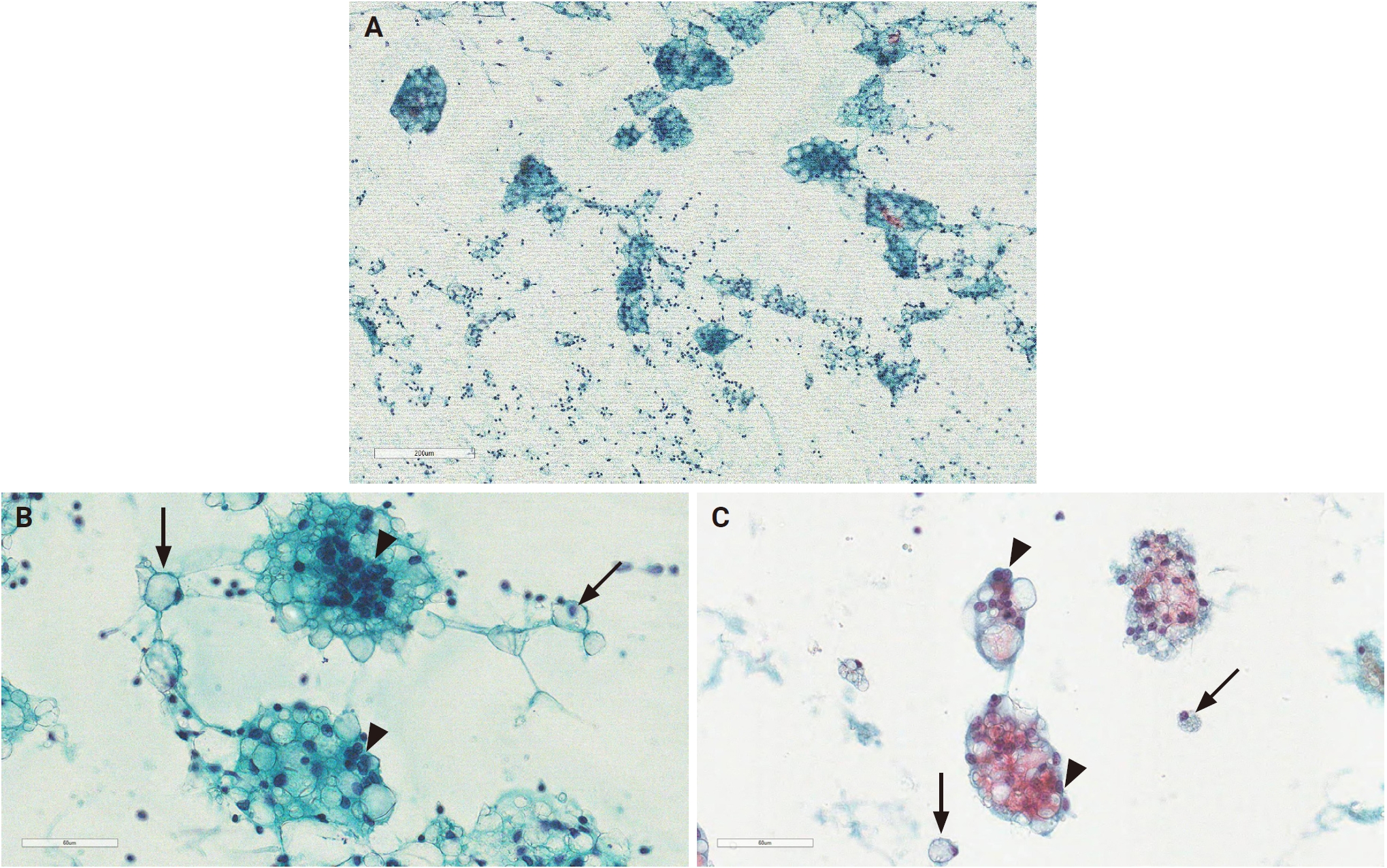
- Silicone lymphadenopathy is an uncommon but well-recognized complication of silicone implant placement resulting from migration of silicone to regional lymph nodes. In patients with prior breast implantation, silicone lymphadenopathy most commonly involves the axillary lymph nodes. Because axillary lymphadenopathy may reflect malignant disease, including metastatic carcinoma, thorough evaluation to exclude neoplasia is essential. Fine-needle aspiration cytology (FNAC) serves as a valuable initial diagnostic modality in the assessment of axillary lymphadenopathy; however, silicone-induced foreign body reactions within lymph nodes may be misinterpreted as metastatic malignancy when silicone lymphadenopathy is not included in the initial differential diagnosis. Herein, a case of axillary silicone lymphadenopathy initially misdiagnosed as metastatic carcinoma on FNAC is presented. This case highlights the importance of recognizing the distinctive cytomorphologic features of silicone lymphadenopathy, which may be sufficiently characteristic to prompt consideration of prior breast implant history during cytopathologic evaluation.
- Heterotopic mesenteric ossification: a report of two cases
- Hisham F. Bahmad, Olga Lopez, Tyson Sutherland, Marisa Vinas, Kfir Ben-David, Lydia Howard, Robert Poppiti, Sarah Alghamdi
- J Pathol Transl Med. 2022;56(5):294-300. Published online September 13, 2022
- DOI: https://doi.org/10.4132/jptm.2022.07.23

- 7,778 View
- 109 Download
- 3 Crossref
-
Abstract
PDF
- Heterotopic mesenteric ossification (HMO) is abnormal bone formation in tissues which usually do not undergo ossification. There are approximately 75 cases reported worldwide. We present two cases of HMO. The first case is that of a 39-year-old man who presented with abdominal pain and a computerized tomography scan of the abdomen and pelvis revealed an apple core lesion resulting in small bowel obstruction. The second case is that of a 36-year-old woman who presented 2 months after undergoing robotic gastric sleeve resection complaining of weakness and emesis. An esophagogram revealed kinking at the distal esophagus. Surgical resection was performed in both, yielding the diagnosis of HMO. There are various theories as to the pathophysiology of HMO, but no clearly defined mechanism has been established. Management should be conservative whenever possible to prevent further ossification with subsequent surgical intervention.
-
Citations
Citations to this article as recorded by
- Bone fragility in a post-intestinal transplant patient with mesenteric heterotopic ossification
Husam Hamshary, Dania S Bacha, Leila Z Khan
JBMR Plus.2026;[Epub] CrossRef - Fatal Moans and Bones in Crohn's
Joyce Opara, Heather Jarrell, Nicole R. Jackson
American Journal of Forensic Medicine & Pathology.2025; 46(2): 151. CrossRef - Heterotopic mesenteric ossification caused by trauma: A case report
Bi-Fang Zhang, Jiang Liu, Shuai Zhang, Ling Chen, Jia-Zheng Lu, Ming-Qing Zhang
World Journal of Gastrointestinal Endoscopy.2024; 16(8): 494. CrossRef
- Bone fragility in a post-intestinal transplant patient with mesenteric heterotopic ossification
 First
 Prev




