
 E-submission

Search
- Page Path
- HOME > Search
Case Study
- Silicone lymphadenopathy of the axilla: a potential for misdiagnosis as metastatic carcinoma on fine-needle aspiration cytology
- Nah Ihm Kim, Hyo-Jae Lee, Ji Shin Lee
- J Pathol Transl Med. 2026;60(6):726-731. Published online November 3, 2026
- DOI: https://doi.org/10.4132/jptm.2026.09.08
- 376 View
- 16 Download
-
 Abstract
 PDF
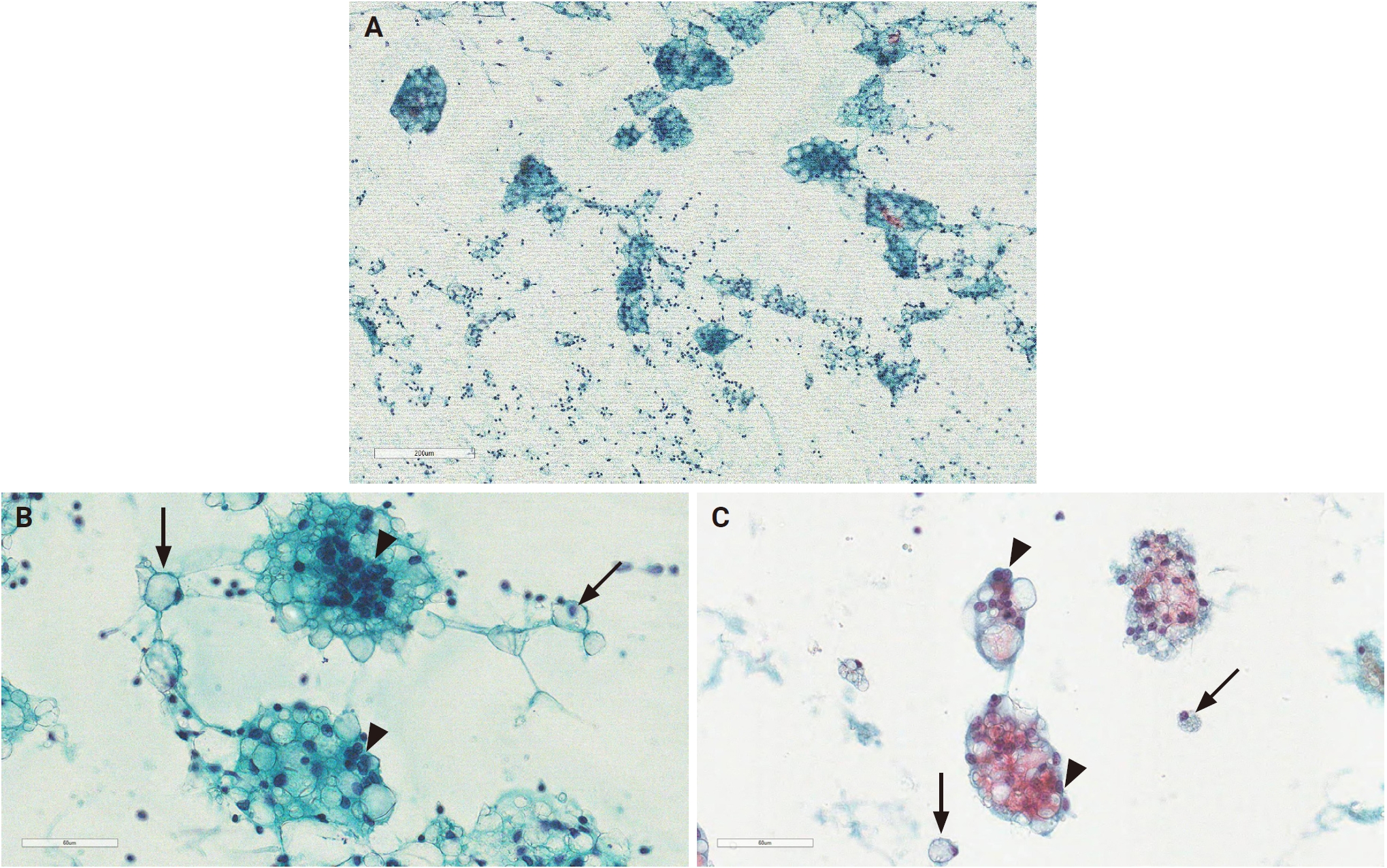
- Silicone lymphadenopathy is an uncommon but well-recognized complication of silicone implant placement resulting from migration of silicone to regional lymph nodes. In patients with prior breast implantation, silicone lymphadenopathy most commonly involves the axillary lymph nodes. Because axillary lymphadenopathy may reflect malignant disease, including metastatic carcinoma, thorough evaluation to exclude neoplasia is essential. Fine-needle aspiration cytology (FNAC) serves as a valuable initial diagnostic modality in the assessment of axillary lymphadenopathy; however, silicone-induced foreign body reactions within lymph nodes may be misinterpreted as metastatic malignancy when silicone lymphadenopathy is not included in the initial differential diagnosis. Herein, a case of axillary silicone lymphadenopathy initially misdiagnosed as metastatic carcinoma on FNAC is presented. This case highlights the importance of recognizing the distinctive cytomorphologic features of silicone lymphadenopathy, which may be sufficiently characteristic to prompt consideration of prior breast implant history during cytopathologic evaluation.
Brief Case Report
- Collagenous Spherulosis Associated with Lobular Carcinoma In Situ of the Breast: Two Case Reports
- Ga-Eon Kim, Nah Ihm Kim, Ji Shin Lee, Min Ho Park
- J Pathol Transl Med. 2018;52(6):420-424. Published online March 29, 2018
- DOI: https://doi.org/10.4132/jptm.2018.03.29
- 9,864 View
- 153 Download
- 2 Web of Science
- 3 Crossref
-
PDF
-
Citations
Citations to this article as recorded by
- Silent but Distinct: Rare Adenoid Cystic Carcinoma of the Breast
Soumiya Samba, Soufiane Berhili, Ahmed BenSghier, Mohamed Moukhlissi, Loubna Mezouar
Cureus.2026;[Epub] CrossRef - Immunohistochemical marker profiles for the differentiation of collagenous spherulosis from adenoid cystic carcinoma of the breast
Henriette L. Warm, Leonie D. Kandt, Nora Schaumann, Christopher Werlein, Malte Gronewold, Henriette Christgen, Malin Hellmann, Marcel Lafos, Bernd Auber, Peter Hillemanns, Hans Kreipe, Matthias Christgen
Human Pathology.2024; 148: 7. CrossRef - Collagenous Spherulosis in Benign Lichenoid Keratosis—Breaking the Monopoly of Breast Lesions
Anurag Sharma, Jeremy Brozyna, Daniel Knabel, Wilma F. Bergfeld
The American Journal of Dermatopathology.2020; 42(8): 620. CrossRef
- Silent but Distinct: Rare Adenoid Cystic Carcinoma of the Breast
Case Study
- Metaplastic Carcinoma with Chondroid Differentiation Arising in Microglandular Adenosis
- Ga-Eon Kim, Nah Ihm Kim, Ji Shin Lee, Min Ho Park
- J Pathol Transl Med. 2017;51(4):418-421. Published online April 4, 2017
- DOI: https://doi.org/10.4132/jptm.2016.10.06
- 10,844 View
- 115 Download
- 5 Web of Science
- 6 Crossref
-
Abstract
PDF
- Microglandular adenosis (MGA) of the breast is a rare, benign proliferative lesion but with a significant rate of associated carcinoma. Herein, we report an unusual case of metaplastic carcinoma with chondroid differentiation associated with typical MGA. Histologically, MGA showed a direct transition to metaplastic carcinoma without an intervening atypical MGA or ductal carcinoma in situ component. The immunohistochemical profile of the metaplastic carcinoma was mostly similar to that of MGA. In both areas, all the epithelial cells were positive for S-100 protein, but negative for estrogen receptor, progesterone receptor, HER2/neu, and epidermal growth factor receptor. An increase in the Ki-67 and p53 labelling index was observed from MGA to invasive carcinoma. To the best of our knowledge, this is the first case of metaplastic carcinoma with chondroid differentiation arising in MGA in Korea. This case supports the hypothesis that a subset of MGA may be a non-obligate morphologic precursor of breast carcinoma, especially the triple-negative subtype.
-
Citations
Citations to this article as recorded by- Two similar but distinct types of breast acinar cell carcinoma: evidence from histological, immunohistochemical and molecular features
Mingfang Sun, Lin Fu, Hongjiu Ren, Jian Wang, Xuyong Lin, Qingfu Zhang
Histopathology.2025; 87(6): 904. CrossRef - Elucidating the nature of acinic cell carcinoma of the breast with high-grade morphology: evidence from case report
Yunjie Ge, Xianping Wei, Jing-Nan Liu, Ping-Li Sun, Hongwen Gao
Diagnostic Pathology.2024;[Epub] CrossRef - New insights into acinic cell carcinoma of the breast: clinicopathology, origin of histology, molecular features, prognosis, and treatment
Yunjie Ge, Xianping Wei, Jing-Nan Liu, Ping-Li Sun, Hongwen Gao
Frontiers in Oncology.2024;[Epub] CrossRef - Metaplastic Matrix-Producing Carcinoma and Apocrine Lobular Carcinoma In Situ Associated with Microglandular Adenosis: A Unique Case Report
Nektarios Koufopoulos, Dionysios Dimas, Foteini Antoniadou, Kyparissia Sitara, Dimitrios Balalis, Ioannis Boutas, Alina Roxana Gouloumis, Adamantia Kontogeorgi, Lubna Khaldi
Diagnostics.2022; 12(6): 1458. CrossRef - Salivary gland-type mammary carcinoma arising in microglandular adenosis: A case report and clinicopathological review of the literature
Victoria Rico, Yukiko Shibahara, Marjorie Monteiro, Elzbieta Slodkowska, Samantha Tam, Pearl Zaki, Carlo De Angelis, Edward Chow, Katarzyna Joanna Jerzak
Cancer Treatment and Research Communications.2020; 24: 100178. CrossRef - Microglandular adenosis is an advanced precursor breast lesion with evidence of molecular progression to matrix-producing metaplastic carcinoma
Christopher J. Schwartz, Igor Dolgalev, Esther Yoon, Iman Osman, Adriana Heguy, Eleazar C. Vega-Saenz de Miera, Diana Nimeh, George Jour, Farbod Darvishian
Human Pathology.2019; 85: 65. CrossRef
- Two similar but distinct types of breast acinar cell carcinoma: evidence from histological, immunohistochemical and molecular features
 First
 Prev




